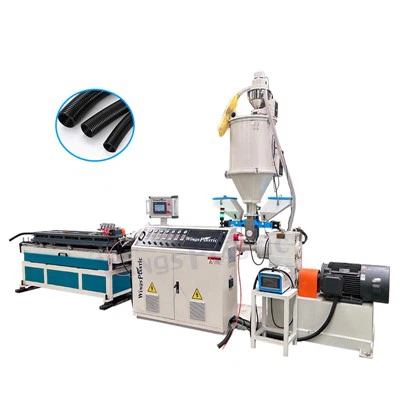
Hey there! I’m a supplier of PVC hose machines, and today I wanna share with you the production process of a PVC hose using one of our machines. It’s a pretty interesting journey from raw materials to the finished product, so let’s jump right in! PVC Hose Machine
Step 1: Gathering the Raw Materials
First things first, we need to gather all the raw materials needed for making PVC hoses. The main ingredient is, of course, polyvinyl chloride (PVC) resin. This is a type of plastic that’s known for its durability, flexibility, and resistance to chemicals. We also need some additives like plasticizers, stabilizers, and pigments.
Plasticizers are used to make the PVC more flexible. They basically act like lubricants between the PVC molecules, allowing them to move around more easily. Stabilizers, on the other hand, prevent the PVC from breaking down when it’s exposed to heat or light. And pigments are just there to give the hose its color. We can make hoses in all sorts of colors, depending on what the customer wants.
Step 2: Mixing the Ingredients
Once we’ve got all the raw materials, it’s time to mix them together. We use a special mixing machine for this. It’s kind of like a big blender, but way more powerful. The machine heats up the PVC resin and then adds the additives one by one. The heat helps the additives dissolve into the resin, creating a homogeneous mixture.
We have to be really careful with the mixing process. The temperature and the mixing speed need to be just right. If the temperature is too high, the PVC can start to break down. And if the mixing speed is too slow, the additives might not mix evenly. So, our operators are trained to monitor these parameters closely to ensure a high – quality mixture.
Step 3: Extrusion
After the mixing is done, the next step is extrusion. This is where our PVC hose machine really shines. The mixed PVC compound is fed into the extruder, which is the heart of the machine. The extruder has a screw inside that rotates and pushes the PVC forward. As the PVC moves through the extruder, it’s heated up to a specific temperature.
The heated PVC is then forced through a die, which is a specially designed tool. The die gives the hose its shape. For example, if we want to make a round hose, we use a round die. The extruded PVC comes out of the die in the shape of a long, continuous tube.
During the extrusion process, we can also control the thickness of the hose wall. By adjusting the speed of the screw and the pressure inside the extruder, we can make hoses with different wall thicknesses to meet the customer’s requirements.
Step 4: Cooling
Once the PVC hose is extruded, it’s really hot. We need to cool it down quickly to set its shape. We use a cooling tank for this. The extruded hose is passed through a tank filled with cold water. The water rapidly cools the hose, making it solid and maintaining its shape.
The cooling process is crucial. If the hose isn’t cooled properly, it can deform or develop irregularities. So, we make sure that the water in the tank is at the right temperature and that the hose moves through the tank at a consistent speed.
Step 5: Cutting
After the hose is cooled, it’s cut into the desired lengths. We use a cutting machine for this. The cutting machine is equipped with a sharp blade that can make clean and precise cuts. The length of the hose is usually determined by the customer’s order. Some customers might want short hoses for a specific project, while others might need long hoses for industrial applications.
We can also cut the hoses with different end finishes. For example, we can make straight – cut ends or angled – cut ends, depending on what the customer needs.
Step 6: Quality Control
Before the hoses are packed and shipped, we conduct a strict quality control process. We check the hoses for any defects, such as holes, cracks, or uneven wall thickness. We also test the hoses for their physical properties, like flexibility, strength, and chemical resistance.
Our quality control team uses a variety of tools and techniques to ensure that the hoses meet the highest standards. If a hose fails the quality control test, it’s rejected and sent back for further processing or recycling.
Step 7: Packaging
Once the hoses pass the quality control test, they’re ready for packaging. We package the hoses in different ways, depending on their size and the customer’s preference. Smaller hoses might be coiled and wrapped in plastic, while larger hoses might be packed in boxes or crates.
We also label the packages with important information, such as the hose size, length, color, and any special specifications. This makes it easy for the customer to identify the hoses when they receive them.
Why Choose Our PVC Hose Machines?
So, that’s the production process of a PVC hose using one of our machines. But why should you choose our machines? Well, first of all, our machines are built with high – quality materials and the latest technology. They’re designed to be reliable, efficient, and easy to operate.
We also offer excellent after – sales service. Our team of experts is always ready to help you with any questions or problems you might have. Whether it’s setting up the machine, troubleshooting, or replacing parts, we’ve got your back.
And if you have any special requirements, we can customize our machines to meet them. We understand that every customer is different, and we’re committed to providing solutions that fit your specific needs.
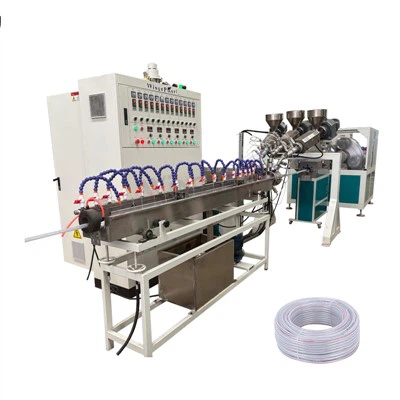
If you’re in the business of making PVC hoses or thinking about getting into it, I highly recommend checking out our PVC hose machines. They can make the production process a whole lot easier and more efficient.
EVA Vacuum Cleaner Hose Machine If you’re interested in learning more about our machines or want to discuss a potential purchase, don’t hesitate to reach out. You can contact us through the appropriate channels to start a conversation and see how we can work together.
References
- "Plastic Extrusion Technology" by John A. Brydson
- "Handbook of PVC Formulating" by Edward J. Wickson
Qingdao Wings Plastic Technology Co., Ltd.
As one of the most experienced pvc hose machine manufacturers and suppliers in China, we also support customized service. Please feel free to buy durable pvc hose machine made in China here from our factory. For price consultation, contact us.
Address: C02 Of Anshengyi Road, No.2 Fuan Industry Zone,Jiaodong Town, Jiaozhou City, Qingdao City, Shandong Province,China
E-mail: kelly@wingsplastic.com
WebSite: https://www.wingsextruder.com/
