If you’ve ever stood in a warehouse, a large manufacturing facility, or a commercial server room feeling stuffy despite a single duct axial fan running, you’ve probably wondered: can duct axial fans be used in parallel to crank up airflow? As a supplier who’s worked directly with facility managers, HVAC contractors, and engineers for over a decade, I’ve answered this question hundreds of times—and the short answer is yes, but with critical caveats that separate a high-performance parallel setup from a costly, underperforming mistake. Duct Axial Fans

Let’s start with the basics: what duct axial fans are, and why their behavior changes when paired in parallel. A duct axial fan pulls air parallel to the fan’s axis, making them ideal for moving large volumes of air through straight, narrow duct runs—think of the big, cylindrical fans in retail store ventilation systems or agricultural drying barns. When you run two fans in parallel, you’re essentially placing them side by side in the same duct section, so each pulls and pushes air at the same static pressure. The goal is simple: double the airflow without doubling the pressure, right? But that only works if you do it correctly.
First, let’s break down the science behind parallel fan operation. Every fan has a performance curve, which plots airflow (CFM, or cubic feet per minute) against static pressure (SP, or air resistance from duct bends, filters, or obstacles). For a single duct axial fan, the curve slopes downward: as static pressure increases, airflow decreases. When you pair identical fans in parallel, their combined performance curve shifts horizontally to the right—meaning at the same static pressure, you get roughly double the airflow of one fan. That’s the theory, at least. But in practice, mismatched fans, poor duct design, or unbalanced airflow can erase those gains entirely.
I remember a project a few years back at a meat processing plant in the Midwest. The facility had a single 36-inch duct axial fan moving 18,000 CFM through a 100-foot duct run with two 90-degree bends and a grease filter. The manager wanted more airflow to meet updated food safety ventilation requirements, so he ordered a second identical fan and had us install it in parallel, no extra duct modifications. For the first week, he called us frustrated: the setup was only moving 17,500 CFM total—less than the two fans added together (18,000 x 2 = 36,000) and way less than the single fan’s output. What went wrong?
We pulled the ductwork apart and found the root cause: poor airflow distribution. The original fan was centered in the duct, but the second fan was installed 12 inches too close to the first, creating a bottleneck in the duct wall that forced air to split unevenly. 60% of the air from the second fan was hitting the duct wall instead of mixing with the first fan’s airflow, so most of the time, one fan was working against the other. We modified the duct section to create a smooth, equal-length plenum for both fans, moved them 18 inches apart, and added guide vanes to straighten airflow before it merged. After the fix, the total CFM jumped to 34,200—almost exactly the sum of the two fans’ individual ratings. That’s when parallel fans work: when their airflow paths are balanced.
Now, let’s talk about when parallel duct axial fans make sense (and when they don’t). First, the right use cases:
-
Boosting airflow without replacing the entire system: If your existing duct run is structurally sound, but you need 20-50% more airflow than one fan can provide, parallel installation is cheaper than swapping to a larger, more expensive single fan. For example, a commercial greenhouse that needs extra air exchange in peak summer can add a second fan to its existing 24-inch duct setup instead of investing in a 30-inch fan that might require reinforced ductwork.
-
Redundancy for critical systems: In server rooms or pharmaceutical storage facilities, downtime is costly. Pairing two fans in parallel means if one fails, the other can still move 60-70% of the total airflow, keeping the space safe. We’ve worked with 12-story office buildings that use parallel fans for their elevator shaft ventilation—if one fan malfunctions, the other prevents smoke buildup during an emergency.
But there are times when parallel duct axial fans are a bad idea:
-
High static pressure duct runs: If your duct has lots of bends, filters, or heat exchangers (static pressure over 1.5 inches WG, or water gauge), parallel fans won’t perform well. When static pressure is high, the performance curve of axial fans drops sharply, and the merged airflow can create back pressure that makes one or both fans stall. We had a customer in a textile factory try this once, and the fans overheated in 45 minutes because they were working against the high pressure from fabric lint filters. In that case, a single high-pressure centrifugal fan would have been a better fit.
-
Mismatched fans: Never pair different-sized or different-model duct axial fans in parallel. Even a 5% difference in CFM rating can throw off the balance, causing the smaller fan to work harder and burn out prematurely. We once had a customer pair a 20,000 CFM fan with a 19,000 CFM fan, and the smaller one failed after 2 months—costing them $1,200 in replacement parts and 3 days of downtime. Always use identical fans from the same manufacturer, with matching performance curves.
Another common mistake: installing parallel fans in series (one after the other) instead of side by side. A lot of people mix these up, and it’s a critical error. Series installation is for increasing static pressure, not airflow. If you put two duct axial fans in a straight line, the first fan builds pressure, and the second fan has to push air against that pressure—so you might get 10% more airflow, but the total static pressure will be too high for your ductwork. Parallel is always for more airflow; series is for higher pressure.
Now, let’s get into the technical details that matter if you’re planning a parallel setup. First, plenum design: the section where the two fans merge must be a straight, equal-length plenum. The distance between each fan and the merge point should be at least 2-3 times the duct diameter, and the plenum should have no sharp edges. Guide vanes (flat metal plates) inside the plenum help smooth airflow so both fans push equal amounts of air into the main duct.
Second, airflow testing. After installation, never assume it works. Use a hot-wire anemometer to measure CFM at several points in the duct—airflow should be within 10% across the entire cross-section. If one side is moving 2,000 CFM more than the other, adjust the plenum or add guide vanes until it’s balanced. We offer on-site testing for customers to make sure their parallel setup is operating correctly, no guesswork.
Third, motor sizing. When you pair fans in parallel, each fan’s motor draws roughly the same amount of power as it would alone, right? Wait—no, not always. If airflow is unbalanced, the fan that’s moving less air will draw more power, because it’s working against back pressure. That means a poorly balanced setup can increase energy use by 15-20% compared to a single fan of the same total airflow. So balancing airflow isn’t just about performance—it’s about saving on electricity bills, too.
I want to share a recent success story to tie this all together. A logistics company in Texas needed to ventilate a 50,000-square-foot warehouse with 30-foot ceilings. Their original setup was four 30-inch duct axial fans running at half capacity, moving 12,000 CFM each. When they expanded the warehouse, they needed 40,000 CFM more total airflow. We didn’t replace the existing fans—instead, we added four more identical fans, paired each original fan with a new one in parallel, and modified the duct plenums. The total CFM jumped to 94,000, which is almost exactly double the original setup’s output. Their energy bill went up only 8%, because the parallel fans were balanced properly—way less than the 50% increase they would have gotten if they’d installed four new larger fans.
So, to circle back to the original question: yes, duct axial fans can be used in parallel for increased airflow, but only if you follow the rules. It’s not a “plug and play” fix—you need balanced plenum design, identical fans, proper airflow testing, and an understanding of your duct’s static pressure. If you skip those steps, you’ll end up with a setup that underperforms, wastes energy, and might even damage your fans.
As a supplier, I’ve seen both the wins and the losses with parallel fan setups. The key is to assess your specific needs: what’s your current airflow, what do you need it to be, what’s your duct’s static pressure, and can you modify the duct to support balanced airflow? If you’re not sure, don’t guess. Reach out, and we can work with your HVAC team to design a parallel setup that fits your space, your budget, and your performance goals.
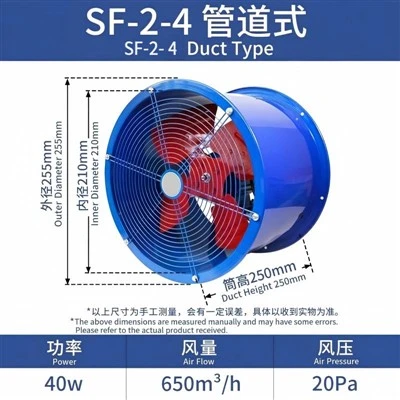
If you’re considering upgrading your airflow, or you’re troubleshooting a parallel setup that’s not working, let’s connect. We’ve helped hundreds of businesses get the most out of their duct axial fans, and we can help you too.
Fixed Axial Fans References
- ASHRAE Handbook—HVAC Systems and Equipment, American Society of Heating, Refrigerating and Air-Conditioning Engineers
- Fan Application and Installation Guide, Air Movement and Control Association International (AMCA)
- Industrial Ventilation: A Manual of Recommended Practice, American Conference of Governmental Industrial Hygienists (ACGIH)
Taizhou Yijia Electromechanical Co., Ltd.
As one of the most professional duct axial fans manufacturers and suppliers in China, we also support customized service. Please rest assured to buy high quality duct axial fans in stock here from our factory. If you have any enquiry about cooperation, please feel free to email us.
Address: No. 47, Jinxing First District, Jintang Village, Jinqing Town, Luqiao District, Taizhou City, Zhejiang Province
E-mail: 826339968@qq.com
WebSite: https://www.yijiablower.com/
